Amida Waterfall on the Kiso Highway is from Katsushika Hokusai's series A Journey to the Waterfalls of all the Provinces. My wonderful husband Will gave it to me for winter solstice. I have ordered it a frame and am eager to display it on a wall in our home.
I wrote about another print from that series - Kirifuri Waterfall - back in 2010, the year I started this blog. I wrote about how the streams of water read like massive, exposed tree roots. This waterfall reads very differently. The stream at the top appears like a moon streaked with blue wood grain. Streams then fall almost straight down; a long line of parallel stripes of various widths, like a bar code. The work elegantly expresses the memorizing beauty and grandeur of a natural monument. As in all of Hokusai's waterfalls (and most of his landscapes in general) the people are dwarfed by the subject, and seem so much more nimble and transient.
Coincidentally, that blog post from 2010 is also the only one which includes a photograph of my beloved.
I love woodcuts and I make woodcuts. On this blog I write about woodcuts I love and woodcuts I make.
Showing posts with label Hokusai. Show all posts
Tuesday, January 9, 2018
Friday, February 28, 2014
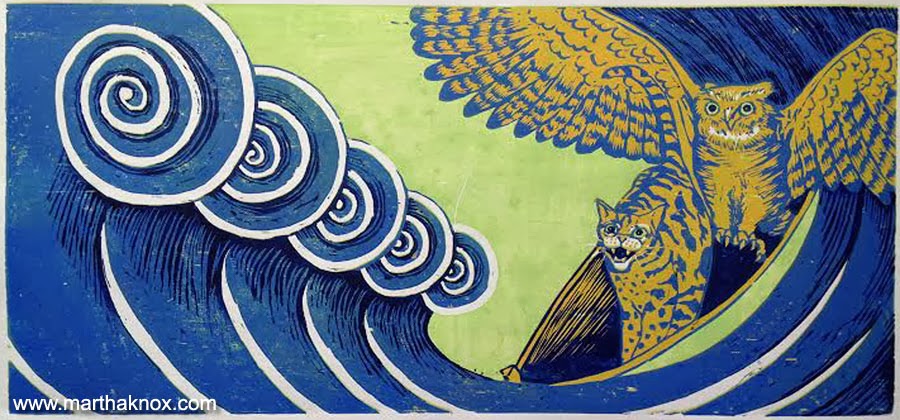
Owl and Cat in Love, "The Wave" (double page spread pages 13-14)
"The Wave"
Woodcut (reduction)
20" x 9.5" (image)
24" x 15" (paper)
Oil based inks on Subi paper
Limited edition of 2
Yet another installment of the Owl and Cat in Love project. Here the lovers' peaceful ocean voyage is abruptly disturbed by a threatening wave.

Anyone out there familiar with woodcuts probably knows that with this print I'm a making small tribute to the Japanese master Hokusai's most famous print, The Great Wave of Kanagawa, often also referred to as The Wave. Although my image puts far more emphasis on the couple's panic, while in Hokusai's, the boats and their inhabitants are enveloped in the great wave that dominates the image.
Hokusai did many wave prints, and I find that my wave print has more in common with a couple of his others. In his "Ocean Waves" print (right), the boats, especially the one in the foreground, are what mainly draws the eye. As in my print, the waves are more of a threat that surrounds the subject.
My overall composition and color palette has more in common with Hokusai's Mount Fuji Seen from the Sea (left), though the main subjects are reversed, where in Hokusai's a cracking wave rises up on the right side, seeming to burst into dots of white, which are actually a flock of birds flying in the distance. In mine that compositional space is taken up by the owl, boosted up by the tilted boat, his wings dramatically unfolding against rushing blue.
All of these prints incorporate stripes of blue and white to describe moving waters, although my print distinctly departs from the Japanese tradition when instead of the water breaking into claw-like curves (a decorative motif which apparently influenced the designs of Western silverware), the crest of my wave continues the lines in a row of spirals. I was going for a somewhat playful association with wheels or spinning machinery, as if my protagonists are being sucked under a steamroller. The closest Japanese print from the ukiyo-e tradition that I can find with a somewhat similar feeling is Totoya Hokkei's Mekari Festival (right.) Run, guys, run!
That's enough about woodcuts and waves for now.
Woodcut (reduction)
20" x 9.5" (image)
24" x 15" (paper)
Oil based inks on Subi paper
Limited edition of 2
Yet another installment of the Owl and Cat in Love project. Here the lovers' peaceful ocean voyage is abruptly disturbed by a threatening wave.

Anyone out there familiar with woodcuts probably knows that with this print I'm a making small tribute to the Japanese master Hokusai's most famous print, The Great Wave of Kanagawa, often also referred to as The Wave. Although my image puts far more emphasis on the couple's panic, while in Hokusai's, the boats and their inhabitants are enveloped in the great wave that dominates the image.
Hokusai did many wave prints, and I find that my wave print has more in common with a couple of his others. In his "Ocean Waves" print (right), the boats, especially the one in the foreground, are what mainly draws the eye. As in my print, the waves are more of a threat that surrounds the subject.
My overall composition and color palette has more in common with Hokusai's Mount Fuji Seen from the Sea (left), though the main subjects are reversed, where in Hokusai's a cracking wave rises up on the right side, seeming to burst into dots of white, which are actually a flock of birds flying in the distance. In mine that compositional space is taken up by the owl, boosted up by the tilted boat, his wings dramatically unfolding against rushing blue.
All of these prints incorporate stripes of blue and white to describe moving waters, although my print distinctly departs from the Japanese tradition when instead of the water breaking into claw-like curves (a decorative motif which apparently influenced the designs of Western silverware), the crest of my wave continues the lines in a row of spirals. I was going for a somewhat playful association with wheels or spinning machinery, as if my protagonists are being sucked under a steamroller. The closest Japanese print from the ukiyo-e tradition that I can find with a somewhat similar feeling is Totoya Hokkei's Mekari Festival (right.) Run, guys, run! That's enough about woodcuts and waves for now.
Sunday, December 12, 2010
"Kirifuri Waterfall" by Hokusai
Full title: "Kirifuri Waterfall at Mount Kurokami in Shimotsuke Province" by Katsushika Hokusai
Hokusai is most famous for his prints of nature (Thirty Six Views of Mount Fuju and the Great Wave of Kanagawa) and what I love most about these and similar works is how exquisitely he renders the natural world, as well as how powerful nature is depicted in comparison humankind. In this sense these works remind me of the cave paintings of Lascaux where elegantly drawn images of stags and bison tower over stick-figure human hunters.
The first time I saw this picture I read the waterfall as the roots of some humongous tree, even though I knew from the color and my familiarity with the style of Japanese woodcuts that it was meant to represent falling water. I had to pull out an old travel photo album to look at a snapshot I took of my husband in front of Ta Prohm - a temple in Cambodia overgrown by gigantic tree roots. In the photo the temple's entrances are dwarfed by slithering, bulbous roots, many thicker than my husband's legs.
The lines of Hokusai's falling streams are just so sharp that at best they reads as thick ropes of ice. That is, until the eye reaches the bottom of the image where the frozen-looking streams finally meet the ground and sizzle up as small waves and mist. The people at the bottom look up, and the people at the top look down, probably at each other, although their respective gazes keep the eye moving up and down the real subject of the piece, and emphasize the waterfall's substantial height. Unlike the waterfall itself, the people's gestures suggest movement. Though the waterfall moves fast, it will be there much longer than them, and the streams' frozen appearance almost seems intended to underscore that deeper truth.
Subscribe to:
Posts (Atom)