Showing posts with label ukiyo-e. Show all posts

Wednesday, January 28, 2015

"In the Tent With Bunny"

I made this for a print exchange: [Baren] Exchange #63. The image is 4.5" x 7.5" and the paper is 7.5" x 10". It is printed in oil-based ink on Sulphite block printing paper. I made an edition of 22 for the exchange and 2 artist's proofs, although I can make more since this is a 2 block print, rather than a reduction.

The theme for this exchange was Moku-hanga (in the spirit of Japanese printmaking.) I spent some time way over-thinking that theme and starting two other sketches and plans for prints before I settled on this one. In my frustration and indecision, I finally just spent some time looking at Moku-hanga print, both from Japanese and International artists, and then followed my intuition. The result is this image of my three-year-old daughter playing with her toy bunny in a tent after a bath.

Admittedly, this is not Moku-hanga in terms of technique and materials because the ink I used is oil-based instead of water-based, and it was rolled on with a brayer instead of painted on. (It simply was not in my budget this holiday season to purchase a whole new set of printmaking inks.) But I think it fits the spirit of Japanese printmaking through the use of vivid colors and translucency, and the subject which makes modern reference to the ukiyo-e (scenes from the floating world) style of wood block printing, with a girl depicted in a domestic scene.

Monday, April 7, 2014

"Kiyochika: Master of the Night" at the Freer/Sackler in DC

The Sumida River at Night
I had the great pleasure to see this exhibition in DC this past weekend and got an up close and personal look at a significant body of work by Kobayashi Kiyochika. Definitely worth the three and a half hour drive from Philadelphia.

It makes such a difference to see these works in person. Prints tends to be smaller than paintings (these were mostly horizontal, about 15 inches across), which emphasizes a more intimate experience similar to reading a picture book. To look at them on a wall, each framed, and one after another is a kind of peering through windows; quietly spying on a foreign land from a bygone era.

A Steam Locomotive in Hazy Moonlight
Kiyochika came of age during the start of the Modern Era in Japan, and his work is reflective of the dramatically transitional Meiji Period in that nation's history. The old and the new Japan are combined seamlessly in most of the images. For example, in The Sumida River at Night, a woman in a kimono is depicted beside a man wearing a Western style hat. (The "man in the hat" was such a prominent reoccurring image that the museum's curators made special note of it in writing.)

As Kiyochika worked in the traditional ukiyo-e style of woodblock printmaking, it was slightly jarring to see imagery of trains and clock towers depicted in that style. I found myself deeply pondering how both threatening and exhilarating it must have felt for the people who lived through such times to see so much rapid change shaped by foreign influences.

Another reoccurring image in Kiyochika's work is the crack in the sky. In these works, it often seems as if something ominous and disapproving is gathering overhead. There is a feeling of helplessness and being guided by mysterious and powerful forces.

The people in Kiyochika's images seem ghostly and anonymous. They are frequently shown in dark silhouette, and often floating, such as when they cast no shadow on the ground. Since the layers of color are often translucent, figures whose forms cross a highly contrasting horizon line are divided by it. It is as if they are dissipating in the rain or hazy evening light. Things are changing, but this is still the floating world.

Asakusa Bridge and the Great Fire at Ryogoku
I felt particularly moved by the images depicting the Great Fire at Ryogoku and its aftermath. During the fire, the structures of the earth and sky merge into one, breathtaking, seething mass of hot destruction. In one print, the typically quietly floating people spring to life and run, though still translucent, ghostly, and at the mercy of greater forces. Afterward, silent, flat outlines of nondescript humanity drifted across the leveled, ragged landscape.

My only disappointment was that the museum produced no catalog for sale. After seeing all the work, I'd resolved to buy one even if it was pricey. Alas, I walked out empty handed.

You can see some shots of the interior view of the exhibition and read another good review of the exhibition by Farrah Skeiky here. The work is up through July 27th, so if you'll be in or near DC before then, check it out. Admission is free!

Friday, February 28, 2014

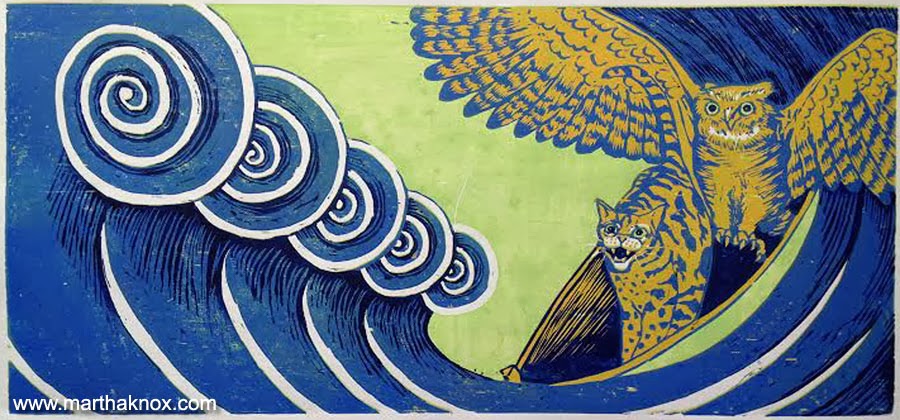
Owl and Cat in Love, "The Wave" (double page spread pages 13-14)

"The Wave"
Woodcut (reduction)
20" x 9.5" (image)
24" x 15" (paper)
Oil based inks on Subi paper
Limited edition of 2

Yet another installment of the Owl and Cat in Love project. Here the lovers' peaceful ocean voyage is abruptly disturbed by a threatening wave. 


Anyone out there familiar with woodcuts probably knows that with this print I'm a making small tribute to the Japanese master Hokusai's most famous print, The Great Wave of Kanagawa, often also referred to as The Wave. Although my image puts far more emphasis on the couple's panic, while in Hokusai's, the boats and their inhabitants are enveloped in the great wave that dominates the image. 

Hokusai did many wave prints, and I find that my wave print has more in common with a couple of his others. In his "Ocean Waves" print (right), the boats, especially the one in the foreground, are what mainly draws the eye. As in my print, the waves are more of a threat that surrounds the subject.  


My overall composition and color palette has more in common with Hokusai's Mount Fuji Seen from the Sea (left), though the main subjects are reversed, where in Hokusai's a cracking wave rises up on the right side, seeming to burst into dots of white, which are actually a flock of birds flying in the distance. In mine that compositional space is taken up by the owl, boosted up by the tilted boat, his wings dramatically unfolding against rushing blue. 


All of these prints incorporate stripes of blue and white to describe moving waters, although my print distinctly departs from the Japanese tradition when instead of the water breaking into claw-like curves (a decorative motif which apparently influenced the designs of Western silverware), the crest of my wave continues the lines in a row of spirals. I was going for a somewhat playful association with wheels or spinning machinery, as if my protagonists are being sucked under a steamroller. The closest Japanese print from the ukiyo-e tradition that I can find with a somewhat similar feeling is Totoya Hokkei's Mekari Festival (right.) Run, guys, run! 

That's enough about woodcuts and waves for now.


Saturday, January 18, 2014

"Above the Clouds" by Hiroshi Yoshida

In the history of Japanese wood block printmaking, I most prefer the late ukiyo-e and shin-hanga that followed (Hiroshi Yoshida falls in the latter category.) The reason is mainly color. Just as the Impressionists and Post Impressionists were having their love affairs with new pigments with which to paint light in all its breathtaking varieties, modern Japanese printmakers were using color in just as sophisticated, expressive, if more subtle ways.

In this image, the outline is barely discernible. The gradations soft and subtle as in a watercolor painting. Mountains, purple and washed over by currents in the thick atmosphere. They rest under clouds that appear like bubbles of sea-foam. In the distance, the tallest mountain rises up like an island. Lonely, yet triumphantly reaching toward another world.