Opportunities
sometimes while walking
there are moments when
all the structures, both
man-made and natural
come together to form a
truly elegant composition
pregnant with meaning
begging for attention and
interpretation
it is important not only to
notice these moments, but also
to take pause
I love woodcuts and I make woodcuts. On this blog I write about woodcuts I love and woodcuts I make.
Saturday, April 5, 2014
Wednesday, April 2, 2014
"Katt Och Uggla (Cat and Owl)" by Kristina Anshelm
When I was poking around the Internet looking for more information on Eva Stockhaus, I discovered this amazing Swedish printmaker, Kristina Anshelm. (Click here to check out her website.)
Two small hunters have perched side by side. Their claws run parallel to the curve of the branch which supports them. Stripes, dashes, and spots; fur, feathers, and bark - it is a symphony of texture. Moonlight reflects on their patches of white so bright as to obscure the hungers' true forms.
She nods toward him, eyes closed, savoring this moment of togetherness.
He remains wide-eyed and gazing forward, vigilant.
Monday, March 31, 2014
Recent Work On Display at Briar Bush Nature Center
I hung my work up at the Treetops Art Gallery at Briar Bush Nature Center's Dede Long Nature Museum. On the walls are small woodcuts from the artist's books I made last November: Scarlett and In My Yard. Downstairs behind the desk at the main entrance are two prints of a Great Horned Owl, from my current book project, Cat and Owl In Love. The common thread in all these woodcuts is that they are inspired by fauna local to the area.
The book In My Yard depicts scenes of plants and small animals seen in my yard in Philadelphia. The small scale and subject of these works connects with an artist residency I'm fullfilling this year with the Wagner Free Institute for Science. In that position I've been teaching woodcut printmaking inspired by insects to middle schoolers enrolled in after school programs. My art curriculum compliments a science curriculum taught by other educators and which focuses on insect lifecycles.
The book Scarlett was specifically inspired by a rescued screech owl who now resides at Briar Bush (as seen in this photograph.) The real Scarlett is regularly featured in Briar Bush's nature education programs for children.
All of the woodcuts in the exhibition plus more from my Cats A-Z book will be for sale in the gift shop. All woodcuts on exhibition and for sale are original art (not reproductions), which is to say hand-carved and hand-printed with a wooden spoon by me.
The Dede Long Nature Museum is open Monday-Saturday from 9-5 and Sunday from 1-5. The Treetops Art Gallery is located on the second floor of the museum. Admission is free for Friends of Briar Bush members and Abington Township residents, and for all others, $3 for adults. $2 for ages 2-17, and free for children under 2. The address is 1212 Edgehill Road, Abington, PA.
Saturday, March 29, 2014
"Tennessee Cove, Marin Headlands" by Tom Killion
Image posted with the permission of the artist. More about Tom Killion can be found at his website, tomkillion.com.
This cove is a good hiding place. Despite the drama of the great, black rock which towers over us like a menacing, torso embedded in onyx, this place is quiet, peaceful. Fragrant flora dot the hillside. The sand is cooled by blue ripples of water. Foamy, green waves slosh against the smaller rock barriers, sounding a rhythmic, seashore lullaby.
But lo, that blindingly yellow sky is ripped open. Behind the tear, orange ribbons flutter by like a flock of dragons. Ready or not, here they come.
Friday, March 28, 2014
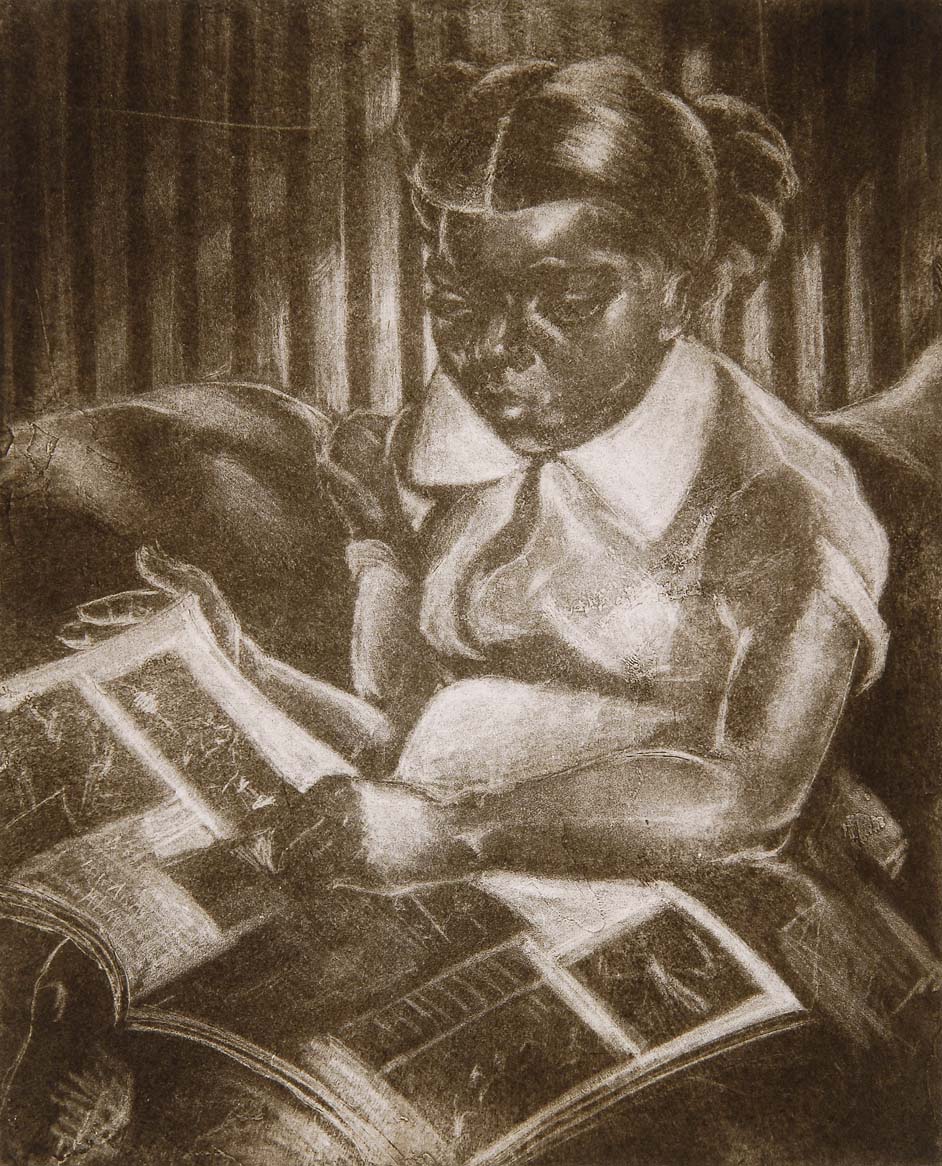
Three Woodcuts from "American Scenes: WPA-Era Prints of the 1930's and 1940's" at La Salle University Art Museum
![]() |
| Boy In the City, Edward Palmer |
What is impressive about this exhibition of fine art prints alone is that while a wide variety of styles and artists from varied backgrounds is represented, the common theme of a specific era in the United States comes across. Although I didn't feature them here because they were not woodcuts, my two favorite pieces from the exhibition were an intensely humanizing mezzotint portrait by Dox Thrash, and a colorful engraving of musicians by Hilda Husik.
Before seeing the works face to face, I was a little worried that I'd encounter images of melodrama and idealized Americana. Some of the prints in the show, at a quick glance, seem as if they could be that. But under closer inspection I saw that through nuance and artful (and often experimental) methods, each artist managed to convey a deep sense of humanity. (Okay, except Thomas Hart Benson's works - I hate that guy's work. It all seems just pretty, but heartless. Maybe I'm missing something.) Taken as a whole, I interpreted certain consistent messages: hope and a sort of quiet endurance as people faced great difficulties, the various associations (both noble and devastating) of hard, physical labor in both rural and urban settings, and an ultimately vibrant human spirit against the backdrop of rapid and monumental change.
![]() |
| Coal Mining, David Burke |
*It was brought to my attention that what I thought was a toy elephant in the bag in the bottom righthand corner of Palmer's Boy In The City, might actually be a scrawny cat crawling into a bag of food. When I looked at the image again, it now seems obvious - mainly based on the context of the image - that it is indeed a stray cat, and not a toy. (This edit was added on 3/31/14.)
My favorite woodcut in the show was David Burke's Coal Mining. The eerie and threatening nature of working underground is conveyed through an unexpected combination of dark hues and slanted beams which seem poised to collapse. The two miners are simple and stylized, yet their gestures are animated. While everything else seems barely scratched into existence, they bulge out and are glowing with heat and movement.
![]() |
| Woodbine, Ernest Watson |
With these three woodcuts alone, I feel I've showcased some of the wide variety of artistic styles featured in the exhibition.
Learn more about the exhibition from the press release. Better yet, if you get a chance, visit the museum (free admission!) Mondays-Fridays, 10am-4pm. And if you can't get to the show but want to have an intimate viewing experience with the works in this show, La Salle has published an exhibition catalog for sale on lulu.
Labels:
American Scenes,
Art Museum,
boy in the city,
Coal mining,
David Burke,
Dox Thrash,
Edward Palmer,
Ernest Watson,
Hilda Husik,
La Salle University,
Martha Knox,
New Deal,
woodbine,
woodcut,
woodcuts,
WPA
Wednesday, March 26, 2014
"After Lunch" by Elizabeth Norton
I first posted on Norton just over a month ago. I find that I'm especially drawn to her style of color woodcuts of animals given the project I'm working on at this time. Here I feature another of Norton's colorful gems:
The abundant grass is swept up in their steady and continuous feeding.
munch munch munch
The white rabbit is tired. He leans against an orange companion, eyelids heavy. His rapid heart-beat slows from a gallop to a mere trot.
ba-boom, ba-boom, ba-boom
One stands on higher ground, eyes open wider, ears perked up straighter than the rest, muscles more tense. She will give the signal, should anything go awry. Not that anything ever does in this domesticated sphere they occupy.
silence
Eating, dozing, and on alert - it is everything they do.
Monday, March 24, 2014
"Early Spring" by Eva Stockhaus
Even though I found many high-resolution images of Eva Stockhaus's wood engravings, the only information about the artist I've found in English was that she was Swedish, lived from 1919-2009, and exhibited primarily in Sweden and sometimes London, England. I only found one book on the artist, but it's in Swedish. I want a copy anyway just for the pictures. This is certainly an artist whose work I will write about more than once.Stockhaus's wood engravings tend to be dramatic, often vertically oriented landscapes, such as this stoic scene of early spring. The image is loaded with subtle symbolism. One thick and gnarly tree stands with branches still bare from winter's sleep, but a gigantic knot, swirling and speckled, emerges from the trunk like a pregnant belly. Another tree's branches, these bursting with new leaves, reaches into the scene and in front of the bare tree. Blooming flowers merely creep into the bottom left corner of the composition. Most dramatically, a flock of birds in black silhouette rise up into flight, and form a dotted path into the sky. Normally, as they connect to spring, birds would symbolize return. But these are flying away from the viewer, which I find intriguing. I invariable conclude that the darkness of their plumage symbolizes the darkness of the coldest season as it slowly recedes and longer days return.
Subscribe to:
Posts (Atom)