|
| Boy In the City, Edward Palmer |
This week I checked out the exhibition
American Scenes: WPA-Era Prints of the 1930's and 1940's at
La Salle University Art Museum. The show featured prints from both the museum's permanent collection and the Free Library of Philadelphia's Print and Picture Collection.
The WPA (
Works Progress Administration) sought to provide employment for artists and bridge cultural divides during the Great Depression by (among other efforts) commissioning a huge number of works of art.
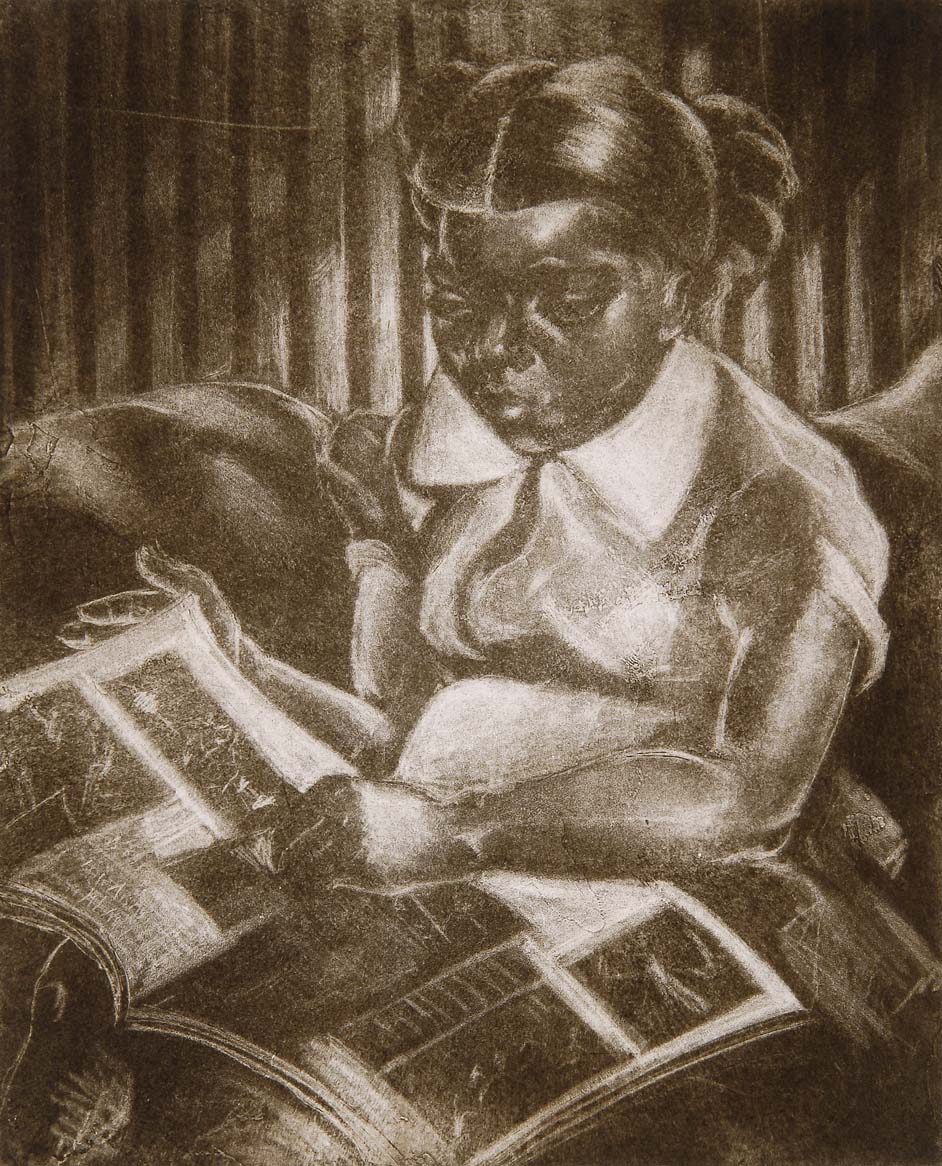
What is impressive about this exhibition of fine art prints alone is that while a wide variety of styles and artists from varied backgrounds is represented, the common theme of a specific era in the United States comes across. Although I didn't feature them here because they were not woodcuts, my two favorite pieces from the exhibition were an intensely humanizing
mezzotint portrait by Dox Thrash, and
a colorful engraving of musicians by Hilda Husik.
Before seeing the works face to face, I was a little worried that I'd encounter images of melodrama and idealized Americana. Some of the prints in the show, at a quick glance, seem as if they could be that. But under closer inspection I saw that through nuance and artful (and often experimental) methods, each artist managed to convey a deep sense of humanity. (Okay, except Thomas Hart Benson's works - I hate that guy's work. It all seems just pretty, but heartless. Maybe I'm missing something.) Taken as a whole, I interpreted certain consistent messages: hope and a sort of quiet endurance as people faced great difficulties, the various associations (both noble and devastating) of hard, physical labor in both rural and urban settings, and an ultimately vibrant human spirit against the backdrop of rapid and monumental change.
 |
| Coal Mining, David Burke |
In this post I've included three of the color woodcuts in the show. The first is Edward Palmer's
Boy In the City. The actual print is about the size of a large book cover. I felt as if I were looking through a window to the past. What most intrigues me about this image is the bag of toys (including a figure of the exotic elephant)
*, beside a boy who appears perhaps too old to play with toys. Or maybe he's just in that transition between boyhood and manhood. His face is in dark show under his cap, and he occupies a cluttered, disheveled environment. But I cannot help but feel that this image contains a great message of hope. It is a soothing moment in time; the background color is distinctly warm, and we see from the angle of the sheets hung out to dry that there is a calm breeze. His gaze points up, and light is shining on this young man.
*It was brought to my attention that what I thought was a toy elephant in the bag in the bottom righthand corner of Palmer's Boy In The City, might actually be a scrawny cat crawling into a bag of food. When I looked at the image again, it now seems obvious - mainly based on the context of the image - that it is indeed a stray cat, and not a toy. (This edit was added on 3/31/14.)
My favorite woodcut in the show was David Burke's
Coal Mining. The eerie and threatening nature of working underground is conveyed through an unexpected combination of dark hues and slanted beams which seem poised to collapse. The two miners are simple and stylized, yet their gestures are animated. While everything else seems barely scratched into existence, they bulge out and are glowing with heat and movement.
 |
| Woodbine, Ernest Watson |
The third print featured here is Ernest Watson's
Woodbine. Though the colors are rather cheery, the scene quiet, and the cow seems rather healthy and robust, I get a strong sense of entropy from this image. The tree, the buildings, and the fence all heavily lean as if being slowly pushed down by their own weight and old age. The blue of the sky is slashed. It all fades and then abruptly vanishes at the edges. Though to some degree this seems a quaint and cozy scene, the impermanence and vulnerability of this way of life weighs heavy in the back of my mind.
With these three woodcuts alone, I feel I've showcased some of the wide variety of artistic styles featured in the exhibition.
Learn more about the exhibition from the
press release. Better yet, if you get a chance, visit the museum (free admission!) Mondays-Fridays, 10am-4pm. And if you can't get to the show but want to have an intimate viewing experience with the works in this show, La Salle has published
an exhibition catalog for sale on lulu.

 This sort of distillation is something woodcuts inevitably do to representational imagery. In my recent post featuring The Round Table of King Arthur, I referred to it as a game of whisper down the lane. We think something is being copied, but it is not. It is being transformed. A specific kind of subtle yet profound change happens with images sourced very directly from photographs, such as this one.