I am intrigued by the pairing of this particular phrase from Ben Franklin's Poor Richard's Almanac with such a lively caricature of this most impressive bird of prey, the Grey Owl.
Both hunting and worrying compel us to narrow our focus while raising our sense of urgency.
More wood engravings from Kenspeckle LetterPress can be found here.
I love woodcuts and I make woodcuts. On this blog I write about woodcuts I love and woodcuts I make.
Showing posts with label wood engraving. Show all posts
Saturday, September 30, 2017
Wednesday, August 9, 2017
The Print Shop at Carillon Park in Dayton
Spending some time with family in Ohio this summer I had the pleasure to visit the Carillon Historical Park's Print Shop. The shop, furnished with 1930's printing equipment, including a press once owned by one of the Wright Brothers, serves as both a museum and functional press, continuing to produce cards, stationary, and notepads.
I was thrilled to purchase a couple sets of notecards, including this 4" x 3" wood engraving of a fish by designer/printmaker Thomas Schorgl, and printed by master printer Robert Smith.
Our tour guide produced the below small print of the park's schoolhouse for my daughter and niece to keep as souvenirs.
The Park is an amazing place, which has only in recent years been renovated and transformed into a top notch museum that showcases the peak of Dayton as a center of innovation and entrepreneurship. The highlight of the Park is of course the original 1905 Wright Flyer III. But any printmakers and printmaking enthusiasts would also deeply appreciate the Print Shop.
I was thrilled to purchase a couple sets of notecards, including this 4" x 3" wood engraving of a fish by designer/printmaker Thomas Schorgl, and printed by master printer Robert Smith.
Our tour guide produced the below small print of the park's schoolhouse for my daughter and niece to keep as souvenirs.
The Park is an amazing place, which has only in recent years been renovated and transformed into a top notch museum that showcases the peak of Dayton as a center of innovation and entrepreneurship. The highlight of the Park is of course the original 1905 Wright Flyer III. But any printmakers and printmaking enthusiasts would also deeply appreciate the Print Shop.
Thursday, March 30, 2017
"Desert Rooster" by Maria Arango Diener
I was sent this print as a gift from one of the participants in Baren Exchange #71. It was one of several gifts in the form of original prints and one hand-made book - certainly encouragement to be volunteer coordinator again some time in the future! This wood engraving of a "desert rooster" (another term for a roadrunner) was a originally created for another Baren Exchange; specifically one to celebrate the Chinese New Year, Year of the Rooster. Maria wrote about it and other prints she has made for that annual exchange on her blog here.
I truly love this small print. It is totally emblematic of the artist's style, influenced by the vast, warm (in both temperature and color) landscape of the American Southwest. Whether working in black and white or color reduction, Maria's prints are layered and create the sort of depth one can get lost in. With this particular print, I have a companion in the foreground with which to enjoy the view. This will be framed and placed on the wall in my living room in Philadelphia (set in a state quite different in character from the Southwest), where I can periodically gaze at it and contemplate the grand and varied qualities of this nation's land, foilage, and inhabitants.
Friday, March 3, 2017
Rebecca Gilbert: Wonder
I highly recommend this exhibit. The singular vision for each work is so boldly executed with a high level of attention to detail. There are both very large and very small works, woodcuts and wood engravings. The imagery is familiar, yet mysterious in how it is presented to the viewer. Everything seems to be placed in delicate balance, so still, yet poised to tip and fall apart if another player enters the scene.
My favorite work in the show was Bear Rattle (first photo shown here). I have a soft spot for children's toys, particularly ones that take something that is fearsome in reality and made harmless and even cute. What I love about this depiction is that the bear is made a bit scary again with how intensely he stares out at the viewer (even his smile is slightly disturbing), and the eeriness of the image is pushed further by the beetle-like shape of rattle that is his "body", the stark black and white rendering of the metal jingles, and the black triangular void that diagonally cuts the space behind him.

I came away from this show with a new work of art for my own collection: Gilbert created the wood engraving Bridge (second photo shown here) for the exhibition and it is for sale at the Print Center for the reduced price of $40 for the duration of wonder.
Wonder is up through April 22. Gilbert gives an artist's lecture on Thursday, March 23 from 6-7:30pm.
A great write-up about the show with many more photos by the Wood Engravers Network can be found here. Rebecca Gilbert's website is here.
Thursday, October 27, 2016
"Twin Sisters" (Wood Engraving)
Oil-based ink on sand-colored paper with wooden particles and fibers
This is my print for Baren Exchange #70 where the technique challenge is "in the style of/or Wood Engraving". My contribution perhaps falls into the category of "in the style of" since it is carved with a dremel (opposed to traditional wood engraving tools). The block used was end-grain Basswood. I completed an edition of 27 for the exchange and another limited edition of 15 to be used in a future promotional campaign for my book project The Nautilus and the Ammonite.
Monday, October 24, 2016
"Elephant Skull"
2.5" x 4.75" (image) 3" x 6" (paper)
Oil-based ink on bright white paper
This engraving is carved with a dremel and the block used was end-grain Basswood. The image is taken from my recent drawings from the collection at the Wagner Free Institute for Science. Earlier this week I also made engravings of a Dolphin Skull and Buffalo Skull.
Sadly, this is a one of a kind print. I'm experimenting with wood engraving for the first time with some unconventional materials, and after creating this Artist's Proof I damaged the block while cleaning it, so no further edition can be printed. Live and learn.
Oil-based ink on bright white paper
This engraving is carved with a dremel and the block used was end-grain Basswood. The image is taken from my recent drawings from the collection at the Wagner Free Institute for Science. Earlier this week I also made engravings of a Dolphin Skull and Buffalo Skull.
Sadly, this is a one of a kind print. I'm experimenting with wood engraving for the first time with some unconventional materials, and after creating this Artist's Proof I damaged the block while cleaning it, so no further edition can be printed. Live and learn.
Saturday, October 22, 2016
"Buffalo Skull"
1.5" x 2" (block) 5.5" x 7.5" (paper)
Oil-based black ink on natural paper
It's my second such engraving (my first posted earlier today in preparation for this one.) The image is taken from my recent drawings from the collection at the Wagner Free Institute for Science.
I'm pretty excited about it. I want to play with my dremel more. Although I need to get some earplugs. My head is throbbing from the sound.
Oil-based black ink on natural paper
It's my second such engraving (my first posted earlier today in preparation for this one.) The image is taken from my recent drawings from the collection at the Wagner Free Institute for Science.
I'm pretty excited about it. I want to play with my dremel more. Although I need to get some earplugs. My head is throbbing from the sound.
"Dolphin Skull"
2" x 1.5" (block) 5.5" x 7.5" (paper)
Oil-based black ink on grayish paper (not sure what types of paper. It was in my scrap stock.)
This is my first "wood" engraving. That's in quotations because I didn't actually engrave wood. Instead I engraved a Resingrave block, a product created to be used in the same way as end grain boxwood, which is the material traditionally used in wood engraving. The primary reason to use Resingrave is the cost is much less. (I purchased it from McClains.) Anyway, I'm not sure how I feel about either the experience or the final product yet other than that I enjoy appearance of the brittle mark-making.
I also didn't use traditional wood engraving tools. Instead I used a dremel. This decision was partially made because of the cost of investing in engraving tools (particularly since I'm just trying out this method for now) and partially because my hands have been hurting more and more frequently after carving and printing. I found using the dremel to feel very similar to using a wood burner, which is to say I had to move it across the surface slowly, apply varying amount of pressure, and the resistance encountered was surprisingly varied despite the Resingrave's uniformity.
Oil-based black ink on grayish paper (not sure what types of paper. It was in my scrap stock.)
This is my first "wood" engraving. That's in quotations because I didn't actually engrave wood. Instead I engraved a Resingrave block, a product created to be used in the same way as end grain boxwood, which is the material traditionally used in wood engraving. The primary reason to use Resingrave is the cost is much less. (I purchased it from McClains.) Anyway, I'm not sure how I feel about either the experience or the final product yet other than that I enjoy appearance of the brittle mark-making.
I also didn't use traditional wood engraving tools. Instead I used a dremel. This decision was partially made because of the cost of investing in engraving tools (particularly since I'm just trying out this method for now) and partially because my hands have been hurting more and more frequently after carving and printing. I found using the dremel to feel very similar to using a wood burner, which is to say I had to move it across the surface slowly, apply varying amount of pressure, and the resistance encountered was surprisingly varied despite the Resingrave's uniformity.
Wednesday, August 10, 2016
"The Fossil Collectors" by Andy English
We lean over to grasp more spiral-shaped relics of a deep past and together we form an arch. A spiral seems as if it could extend into infinity, coiling into the infinitesimal or expanding out to the unimaginably enormous. But that is only in the abstract realm of our imaginations. In reality, we bend into a tumble, curl over our feet, and hoping to soar instead we find the floor.
Tuesday, August 9, 2016
Mermaid and Sea Monster by Giovanni Andrea Maglioli
In the picturebook Fish Is Fish by Leo Lionni a fish and tadpole are childhood friends, but eventually the tadpole becomes a frog and leaves the pond for the surface world. In time the frog returns and tells his old friend about the wonders and strange creatures who live above. In the illustrations (see below), we see that the fish imagines all these creatures as fish-like. The first time I read the book to my kids I thought ,Yes, we do this, and what a playful way to bring it up.
I've been looking at old woodcuts and engravings of chimeras, demons, and map monsters, and they are so much like Lionni's fish in the sense that in describing what is unknown to us, we fill in the gaps with what we do know. When I look at images such as this masterful wood engraving by Giovanni Andrea Maglioli, I cannot help but feel as if the creatures depicted are in two different worlds simutaneously. The aspects of these two beasts that are of land are so utterly terrestrial that I have difficulty even believing that they are under water. The current underneath reads more like long locks of hair. And yet, other aspects float and bulge and curl in a way that seems impossible on land. My mind cannot resolve this discrepancy. I do not believe this fantasy, so matter how detailed and haunting the illustration.
Saturday, March 19, 2016
"Spring Melt" by Rick Allen
When sunlight shines through water vapor that hovers just over a crystal-clear pool of refreshing drink, it is impossible to turn back and see what has been.
I discovered the wonderful artist/illustrator Rick Allen just today while perusing books at a local bookstore. Specifically, I pulled Winter Bees & Other Poems of the Cold off the shelf, a picture book of nature poetry written by Joyce Sidman and illustrated with Allen's colorful relief prints. I immediately looked up more of Allen's work after I came home. There were too many lovely prints I'd love to feature on this blog, so I quickly settled on something seasonally appropriate and depicting an animal that happens to be my favorite color.
Reproductions, cards, books, and calendars featuring Allen's work can be found and purchased here.
I discovered the wonderful artist/illustrator Rick Allen just today while perusing books at a local bookstore. Specifically, I pulled Winter Bees & Other Poems of the Cold off the shelf, a picture book of nature poetry written by Joyce Sidman and illustrated with Allen's colorful relief prints. I immediately looked up more of Allen's work after I came home. There were too many lovely prints I'd love to feature on this blog, so I quickly settled on something seasonally appropriate and depicting an animal that happens to be my favorite color.
Reproductions, cards, books, and calendars featuring Allen's work can be found and purchased here.
Tuesday, May 26, 2015
"Into the Pond" by Nancy Darrell
This is a wood engraving by Nancy Darrell, another artist I discovered in the Arrowmont School of Arts and Crafts gift shop in Gatlinburg, Tennessee.
The swimmer, a solid, naked form, plunges into the deep. Her presence is a disturbance. While other creatures merely release gently floating bubbles, her bold and deliberate movements scratch through the previous calm.As she heads down into the dark, the ripples she's created will travel across the surface until they bounce against the edge of the shore from which she came.
Saturday, November 29, 2014
"Water Shake" by Leslie Evans
Image posted with the permission of the artist. More prints by Leslie Evans can be viewed and purchased at Sea Dog Press.
A moment comes, when burdened by so much precipitation, action is taken. Muscles engage and send the body into so much convulsion that the weight of wetness is driven out in all directions. In the center of the sailing mists emerges the silhouette of a being reborn.
Sunday, August 31, 2014
"Olivia Painting" by Beth Krommes
Image posted with the permission of the artist. More wood engravings and other artwork by award-winning illustrator Beth Krommes can be found at her website.
Young children often seem light and airy like little birds. They scurry and giggle. Their stomps weigh less than our steps, though a child's scream can be shrill.
But every once in a while a child falls silent, heavy, her concentration poured into peering through a window to another dimension. The sounds, smells, and patterns of the domestic scene she knows so well continue all around her: the running water, the mingling scents of toast and fresh autumn air, mom's polka-dot dress. But for this moment, she is no longer present in that world. She is too busy being the creator-god in another.
Young children often seem light and airy like little birds. They scurry and giggle. Their stomps weigh less than our steps, though a child's scream can be shrill.
But every once in a while a child falls silent, heavy, her concentration poured into peering through a window to another dimension. The sounds, smells, and patterns of the domestic scene she knows so well continue all around her: the running water, the mingling scents of toast and fresh autumn air, mom's polka-dot dress. But for this moment, she is no longer present in that world. She is too busy being the creator-god in another.
Thursday, August 21, 2014
"Of A Feather - An Avian Alphabet" by Colin See-Paynton
In my last post I wrote about the wonderful color linocuts of Christopher Wormell, and his creative use of vocabulary in a counting book. Today I present Colin See-Paynton's stunningly detailed wood engravings for a bird-themed alphabet book. This book also happens to employ the use of creative vocabulary.Instead of seeking out nouns for types of birds that match with all of the letters of the alphabet, which would no doubt lead to some difficulty with certain letters (I'm talking about you, X) and put in place certain restrictions for the artists, See-Paynton chose to match each letter with an entire phrase about each group of birds. The result is a sort of unexpected elegance of language that matches perfectly with the ceremonial composition and ornately detailed imagery.
The sampling here includes Parliment of Owls, Irascibility of Robins, Tiding of Magpies, and Quietude of Swans. The owls and swans sit at rest, couched in the image's frame, while the magpies disperse outward, and the robins swarm toward a fellow in the center, In all of them the figures are tightly arranged and completely contained within the frame. This is what gives the composition a sort of ceremonial look. All four of these also showcase a rather balanced mix of black and white and breathtaking array of textures for the viewer to explore.
You can find the entire collection for viewing online here. The book and exhibition catalog can be found for purchase at the artist's website here.Monday, July 14, 2014
NAKED JULY: Male Nudes by Rockwell Kent
Here are five 1930's wood engravings by Rockwell Kent, from top to bottom: Greenland Swimmer, Fair Wind, Bowspirit, Bather, and Hail and Farewell.
Though the images are are not explicitely sexual, I was immediately struck by their sensual, erotic qualities. Each man's body is muscular, unblemished, and ideally proportioned, yet also appears soft to the touch. The "swimmer" is not swimming, but leans to firmly grip a paddle. The "bather" is not bathing, but strikes a flirtatious, seated pose. Two of the figures balance with a ship's spar between their legs, bobbing over gently churning waters.
That they are not explicit or aggressive in their sexual provacation strikes me as even more titilating because the men seem secretive and coy.
The last of these wood etchings appeared in the 1995 exhibition Male Desire: Homoerotic Images in 20th-Century American Art. The show was organized by art historian Jonathan Weinberg, who:
"...proposes that the sexualized image of the male body has carried different meanings in different eras and that homosexual content is by no means always conscious. By mixing homosexual and heterosexual artists in the show (as the exhibition 'In a Different Light' did recently in San Francisco), he suggests that esthetic fashion and political beliefs can play as important a role as sexual orientation in creating 'homoerotic' images."
Even though the style of these figures is indeed emblematic of the period, part of me still finds it difficult to believe that Rockwell Kent, in his inspiration and creation of them, felt no sexual attraction to the male form.
Though the images are are not explicitely sexual, I was immediately struck by their sensual, erotic qualities. Each man's body is muscular, unblemished, and ideally proportioned, yet also appears soft to the touch. The "swimmer" is not swimming, but leans to firmly grip a paddle. The "bather" is not bathing, but strikes a flirtatious, seated pose. Two of the figures balance with a ship's spar between their legs, bobbing over gently churning waters.
That they are not explicit or aggressive in their sexual provacation strikes me as even more titilating because the men seem secretive and coy. The last of these wood etchings appeared in the 1995 exhibition Male Desire: Homoerotic Images in 20th-Century American Art. The show was organized by art historian Jonathan Weinberg, who:
"...proposes that the sexualized image of the male body has carried different meanings in different eras and that homosexual content is by no means always conscious. By mixing homosexual and heterosexual artists in the show (as the exhibition 'In a Different Light' did recently in San Francisco), he suggests that esthetic fashion and political beliefs can play as important a role as sexual orientation in creating 'homoerotic' images."
Monday, March 24, 2014
"Early Spring" by Eva Stockhaus
Even though I found many high-resolution images of Eva Stockhaus's wood engravings, the only information about the artist I've found in English was that she was Swedish, lived from 1919-2009, and exhibited primarily in Sweden and sometimes London, England. I only found one book on the artist, but it's in Swedish. I want a copy anyway just for the pictures. This is certainly an artist whose work I will write about more than once.Stockhaus's wood engravings tend to be dramatic, often vertically oriented landscapes, such as this stoic scene of early spring. The image is loaded with subtle symbolism. One thick and gnarly tree stands with branches still bare from winter's sleep, but a gigantic knot, swirling and speckled, emerges from the trunk like a pregnant belly. Another tree's branches, these bursting with new leaves, reaches into the scene and in front of the bare tree. Blooming flowers merely creep into the bottom left corner of the composition. Most dramatically, a flock of birds in black silhouette rise up into flight, and form a dotted path into the sky. Normally, as they connect to spring, birds would symbolize return. But these are flying away from the viewer, which I find intriguing. I invariable conclude that the darkness of their plumage symbolizes the darkness of the coldest season as it slowly recedes and longer days return.
Sunday, March 9, 2014
Barry Moser's Uncommonly Expressive Animals
This weekend I stumbled upon a picture book illustrated with the most exquisite hand-colored wood engravings. The book was Ever Heard of an Aardwolf? and the illustrator was American artist Barry Moser.
Even though I found this book in the Children's library area of the Academy of Natural Sciences, it is hardly only for children.
Moser is a serious artist with a prolific career and his own imprint, Pennyroyal Press. Many of his stunning black and white original engravings (which sell for hundreds each) depict animals.
This book in particular included type designed by Eric Gill, lettering by Judythe Sieck, and was printed on Mohawk Superfine paper. I might have found it among many cheap, mass-produced, mediocre books for kids, but it was a gem among pebbles.

Most importantly, the imagery is certainly sophisticated enough to be enjoyed on a high level by an adult audience.
What most captivated me about the animals in this book were the emotions conveyed by the animal's facial expressions (especially in the eyes), and sometimes the gestures of the bodies. The okapi glancing down as if caught in a moment of wistful reflection. The zebu who stares down the viewer with a haughty frown.
Obviously I can't (or at least shouldn't) repost a significant portion of someone else's book here. But I can at least give a small taste with these three, low-resolution details of primates wearing tremendously human expressions. I highly encourage anyone who enjoys wood engravings and/or animal art to seek out this book and see the whole collection of works in its full glory.
Even though I found this book in the Children's library area of the Academy of Natural Sciences, it is hardly only for children.
Moser is a serious artist with a prolific career and his own imprint, Pennyroyal Press. Many of his stunning black and white original engravings (which sell for hundreds each) depict animals.
This book in particular included type designed by Eric Gill, lettering by Judythe Sieck, and was printed on Mohawk Superfine paper. I might have found it among many cheap, mass-produced, mediocre books for kids, but it was a gem among pebbles.

Most importantly, the imagery is certainly sophisticated enough to be enjoyed on a high level by an adult audience.
What most captivated me about the animals in this book were the emotions conveyed by the animal's facial expressions (especially in the eyes), and sometimes the gestures of the bodies. The okapi glancing down as if caught in a moment of wistful reflection. The zebu who stares down the viewer with a haughty frown.
Obviously I can't (or at least shouldn't) repost a significant portion of someone else's book here. But I can at least give a small taste with these three, low-resolution details of primates wearing tremendously human expressions. I highly encourage anyone who enjoys wood engravings and/or animal art to seek out this book and see the whole collection of works in its full glory.
Sunday, February 16, 2014
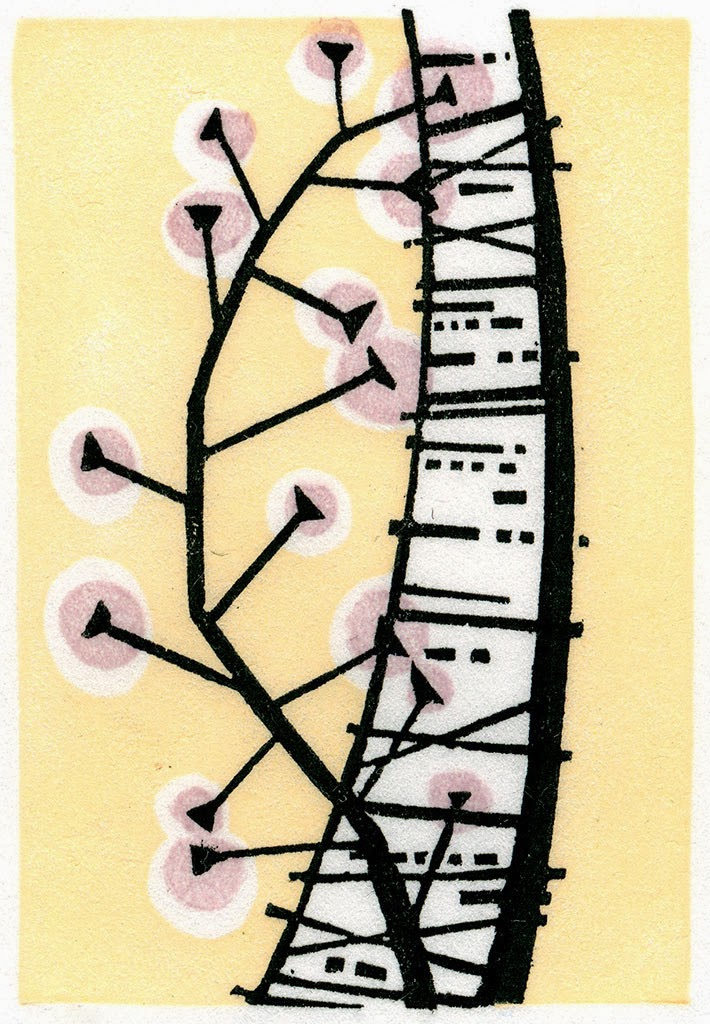
"Birch" by Angie Lewin
Image posted with the permission of the artist. More of Angie Lewin's wood engravings and other works of art can be found at her website.
The trunk gently curves, like the raised arm of a conductor, or giraffe's neck. I hear music. Soothing chimes emanate from the soft, pink blossoms on a geometric bouquet. The lyrical, dotted-line interruptions in the pale bark tink, ping, and zoot. I feel as if I've encountered an alien dancer, camouflaged in the snow.
Sunday, July 28, 2013
"The Workroom Window" by Howard Phipps
The typewriter, lampshade, and chair beckon the artist to return. A line of books lean and fill the emptiness where others have been taken down for reference. Disheveled papers litter the adjoining desks. The clock ticks, an ever-present reminder of deadlines. There are always deadlines, some set by us, some by fate. And there is always work to do. Thank goodness, there is always work to do.
Learn more about the art of Howard Phipps here.
Subscribe to:
Posts (Atom)