...continued from yesterday:
 Transmission #3 by Howard Paine
The great blackness, simultaneously bulging and voice, reaches out toward the left, activating buds which grow red with stimulation. The neglected counterparts on the right remain still and gray, but their time will come soon enough.
This print resonated personally for me as I've just endured a five day hospital stay for pancreatic followed by two procedures to remove a pancreatic stone which was causing the trouble. Afterward the doc gave me photographs taken inside my gut. It felt amazing to see photographs taken by a tiny camera which had traveled down my throat all the way down to my digestive organs. The technological possibilities today are so impressive, yet creepy. The creepy often comes out in how medical staff speak to worried patients; at some point the doctor told me that if this procedure didn't work they'd have to "filet" a valve. Um, can we not talk about my organs using a butcher's vocabulary? But the fact is, the technology fixed a problem. No more pain, and they didn't even have to open me up.
Ah, what mysterious worlds exist within the wholes of bodies and on the level of viruses and cells. How alien it appears when we look close enough. Even more-so when we dare to touch.
Howard Paine's organic work (check it out on his website) is a sort of visual quest into the strange and small, if not microscopic environments where naturalists and scientists dare to tread. He begins with having direct contact with his subjects, but the images develop through an elaborate process that often combines traditional printmaking with digital assemblage and machine printing.
In his statement he says he wants to "start a conversation." Certainly so many mysterious, often ominous, yet oddly familiar images hold that potential. I particularly love that he makes images of butterflies which are not pretty.

Runoff by Bill Pangburn
Is this the mess we mean to clean up after the fact? Or is it what we were seeking the whole time, and just didn't know? I thought I wanted to go home and sit in a freshly-vacuumed living room. Maybe read a book. Some New York Times best seller featured twice on NPR. But now I'm not sure. Something is nagging at me. I feel I need to stay here and witness this. Not speak or otherwise interact. Just witness.
Bill Pangburn creates purely abstract works. In all the many examples of installations and works on paper from his website, lines of varying thickness and color slither, drip, are draped, or otherwise work their way down a vertical composition. Each is titled specifically, and after looking at the whole collection, the title "Runoff" does seem most appropriate for this particular image. Pangburn is one of those artists who has found a keyhole through which to discover the whole world; a body of work such as his shows the limitlessness of variation.
 Ruckenfigur by Barry O'Keefe
I think I know that guy... no, nevermind.
Barry O'Keefe has a large number of other wonderful woodcuts featured on his website, including a couple more ruckenfigurs, sleeping subjects, and portraits in profile in the portraits section - I totally feel like a creeper who stares at people at coffee houses or on the bus after checking those works out. But in a good way.
O'Keefe is an up-and-coming, socially-conscious artist. Still in his 20's and working on his MFA at Ohio University, he's already had a significant impact in his hometown of Richmond, Virginia; the East End Cemetery where many African American residents were buried had become overgrown from neglect. O'Keefe created limited edition woodcut portraits of three of the most prominent people who were buried there and then sold them to raise money toward the restoration efforts. Learn about those portraits here, and an article in Style Weekly from earlier this year here.
I look forward to following O'Keefe's career and seeing what he creates in the years to come.
 ...continued from yesterday:
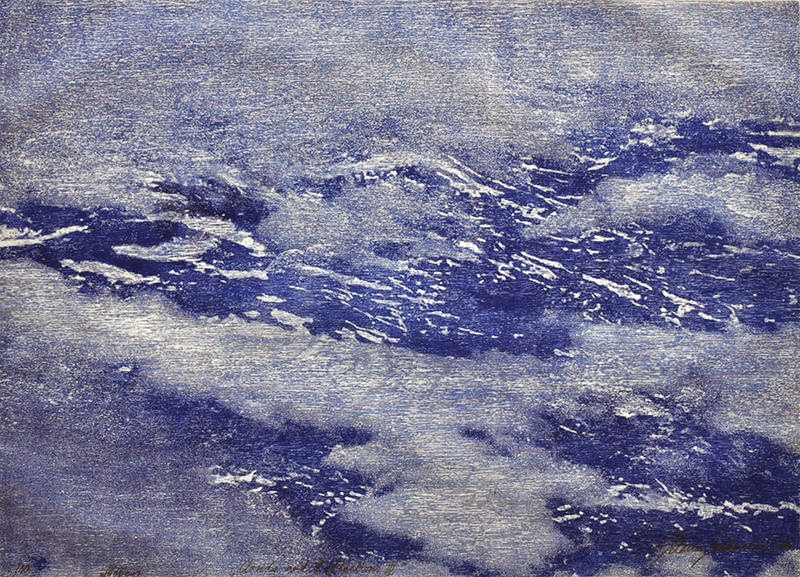
Clouds and Reflections III by Jelena Sredanovic
Dreamed I was a bird
Flying above the clouds, where
Boundaries mean nothing.
Sredanovic has a whole series of woodcuts of clouds, as well as woodcuts of reflections, shadows, and ripples in water. What a remarkable challenge: to capture in a still image that which is so fluid and translucent using wood, which is so solid and opaque, not to mention difficult to carve.
As I learned from her website, Sredanovic earned her MFA from the Academy of Fine Arts in Novi Sad in 2005 and is now working on her PhD at the University of Arts in Belgrade. She shows regularly in Serbia and Spain, as well as other parts of the world.
 Waterway by Gesine Janzen
At first I think I notice only the creek. It is an odd, meandering shape, like a wrench that's being melted down for scrap. I see that across the way there are trees, and much closer to where I stand there are low-lying plants, reeds and such. Nothing is in focus, and the colors are so muted and grey. Not muddy grey, but cold. The longer I look, the more it seems that everything around here is disintegrating. As the pieces fall away, I notice more water. Water seeped into cracks and other unassuming spaces. Water from the sky. Water underground. Water that makes a squishing noise when it mingles with the earth under my feet. I see how the water belongs to everything.
Gesine Janzen is a prolific printmaker; her portfolios (which you can check out on her website) feature mostly color woodcuts. Her work reflects a deep connection to the American Midwestern landscape. Waterway is from a whole series depicting the Missouri River. Being from the Midwest myself, I recognize the vastness and peaceful solitude.
 Architectural Possibilities (Articulation no. 20) by John-Marc SchlinkI find myself pondering the play between what is (merely? breathtakingly?) possible and what is (disappointingly? astoundingly?) real. The seductive power of Platonic forms verses the flawed reality that feeds us. A hastily-written notation on a preliminary blueprint verses a solid, metal pipe.
Schlink teaches at Hamline University and is better known for his intaglio prints. Indeed, this print is a woodcut over an intaglio print. It is part of a whole series of Architectural Possibilities. I love how the rough textures of the woodcut portions of the image interact with the much more precise and shadowy etched portions.
Continue on to the third and final installment of this exhibition review.
This is the start of a rundown of thoughts about the woodcuts featured in New Prints 2014/Summer at the International Print Center New York. I'll post three more artists tomorrow and a final three on Wednesday. For any printmakers out there, IPCNY takes submissions for its New Prints shows three times a year. Best of all, no submission fees. Learn how to submit and join the email list here.
Earth, by Brenda Malkinson.
From a far enough distance, the storm is lovely and calm. Two atmospheric swirls over a topsy turvy sky form the eyes of a giant bird who overlooks the celestial dawn. This ocean that is our everything is poured out like grains of sand through an hourglass. The end of the world will not bleed. It will burn, slowly, but for now, let's go for a quick dip.
Malkinson makes glass artworks and woodcuts. (Check out her website here.) Wood and glass are such different materials, but what they have in common is an emphasis on an arrangement of shapes and on the natural textures of the materials themselves. Both are used in the rigid and geometric construction of buildings (supportive beams, windows), and yet both lend themselves well to the creation of organic forms. Both inevitably contain an array of subtle imperfections (cracks in the wood, bubbles in the glass), particularly when worked by a single artist's hand.
Irish Standing Stone II by Jim Lee
Everything moves at its own pace. It's odd to encounter a rock that stands upright, such as myself, as if we are two souls who have met in the street and have paused to size each other up. The clouds above move rapidly in the wind. That same wind tickles the grass to quiver. There is a long, stone wall and white house in the distance. This fellow has been here much longer than they have.
Jim Lee enjoys a successful career, having exhibited internationally and founded Blue Moon Press over 30 years ago. He also teaches at the Hartford Art School. While I obviously love this print, I like his color prints and the more whimsical imagery featuring animals even better. So I'll keep that in mind for future posts. You can find some of his works online here and here.
 A Travers (Through) by Luca Cruzat
You can never be sure just what will happen when you walk through a door.
Luca Cruzat has a pretty fantastic artist's website and blog. She works with several art-making materials, including collograph and screenprintmaking, thread and paper, and 3D works using thread, fabric, paint, and more.
On her website, her woodcuts are the most purely abstract works. It's far more satisfying to see them all together as a series than to just see this one, since together a more thorough exploration becomes apparent of what can be expressed with the grain of the block and just a few traditional cutting techniques.
I also really like what Cruzat has done combining woodcuts with other printmaking techniques in her Recent Works, particularly using uniquely woodcut-derived textures to enhance the expressive quality of the images.
To be continued...


.png)